
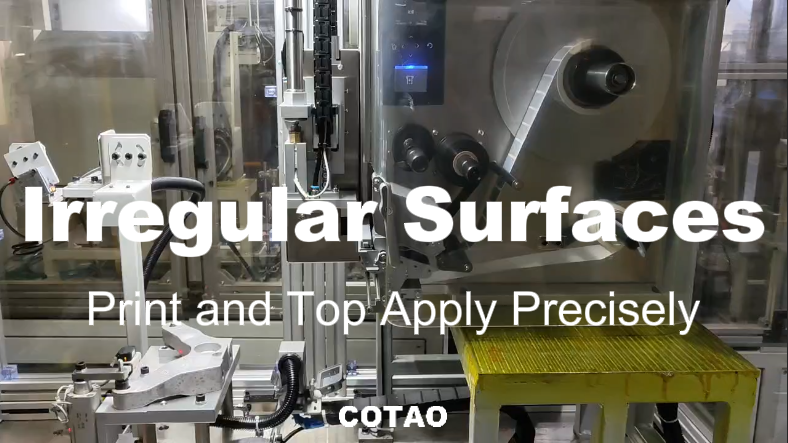
In high-end manufacturing industries such as automotive and electronics, automated coding, automatic identification, and full process traceability of precision components have become essential parts of modern production management.
Laser marking offers high clarity, but because it damages the surface layer of parts and is non-removable, it is not suitable for production environments where reworkable or replaceable identification is required. Inkjet printing can reduce consumable costs, but similar to laser marking, the print quality decreases when applied to surfaces with curvature. This limitation makes it less suitable for applications that require reliable automatic identification and scanning in subsequent production processes.
Therefore, automated print-and-apply labeling on irregular surfaces of precision parts has become a more ideal identification solution.
The surfaces of precision components are rarely perfectly flat. Traditional rigid label tamp applicator often cause upturned corners, bubbles under the label, or positioning deviations during the labeling process, which negatively affects product appearance and barcode readability. As a result, high-end manufacturers in the automotive and electronics industries require more stable and reliable automatic print and apply labeling systems.
In this electric vehicle component labeling case, the label length is only 20 mm with a print width of 40 mm. Two types of components are involved, each with different shapes and varying curvature on the labeling surfaces.
The project adopts Cotao’s hot-selling H400A High Printer Applicator, equipped with a dual label sensor design in the print engine, achieving a positioning accuracy of ±0.5 mm even for small labels. With a 300 dpi thermal transfer print resolution, the system can clearly print small 2D barcode, variable text, and logo image.
A ultra-high elastomer is added to the labeling plate, allowing the plate to provide buffering and adaptive contact when touching the surface of precision parts. This enables the label to better conform to unflat labeling surfaces, ensuring smooth label adhesion and improved barcode readability.
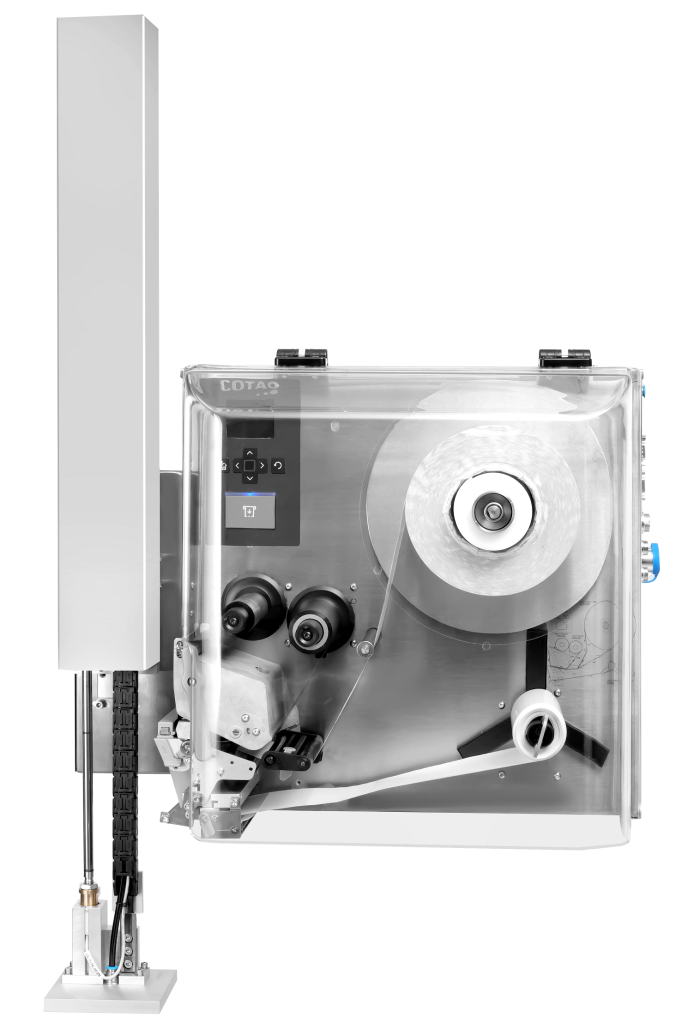
The high-speed, long-life air tamp applicator is equipped with a labeling pressure sensor, enabling adaptive adjustment to different labeling positions. This ensures stable performance under the strict repeatability requirements of industrial production.
The entire labeling process is seamlessly integrated with the customer’s MES production management system and PLC via Profinet/IO communication. When a component enters the labeling station, the H400A automatically print and apply the label. After labeling, parts clamping fixture automatically moves to a scanning inspection station, where the labeling result is verified.
If issues such as incorrect codes, unreadable codes, missing codes, or scanning failures are detected, the system automatically triggers a reprint and re-labeling process, ensuring that every component carries accurate printing information.
Through the implementation of this project, the user achieved the following results:
- Flexible Label Designing: Barcodes and variable data are generated by the MES system and transmitted directly to the H400A for printing.
- High-Precision Label Printing: With 300 dpi thermal transfer printing, the system prints clear barcodes, 2D codes, serial numbers, product traceability information, and company logos on 40 × 20 mm silver PET labels.
- Automated Labeling Process: The H400A High Printer Applicator prints and applies labels in a single integrated process, enabling efficient top-side labeling of electric vehicle components on automated production lines.
- Stable and Accurate Label Placement: The air tamp applicator ensures reliable label application even on irregular surfaces, achieving ±1 mm labeling tolerance to meet strict production requirements.
- Irregular Surface Labeling for Precision Parts: The customized adaptive labeling plate is specifically designed to conform to non-flat surfaces of components, improving label adhesion quality.
- Industrial Automation Integration: The system can be integrated with automated inspection systems, automation control systems, and MES (Manufacturing Execution System), supporting intelligent manufacturing environments.
The Cotao H400A print and apply labeling system reduces human errors caused by manual operations while improving the consistency of label printing and application. The downstream label scanning and verification process can promptly detect abnormal labels, improving product traceability accuracy.At the same time, it helps manufacturers establish a more reliable automated identification system, making production processes smarter and more efficient, while providing a stable data foundation for digital manufacturing and quality management.
Keywords: industrial print and apply labeling system, parts top side labeling, industrial parts labeling, automated component labeling, label printing and applying system, label scanning inspection, automatic labeling equipment, automated parts labeling solution for manufacturing, high precision print and apply labeling machine, industrial label printer applicator for parts, automatic labeling system for Irregular surfaces, parts top labeling with barcode verification