
Keywords: carton print and apply labeling, automatic carton labeling, automatic carton print and apply, carton label coding, real-time print and apply, carton side labeling, printer applicator, print and apply automation, conveyor print and apply labeling, PLC-integrated labeling, carton palletizing, labeling and palletizing integration, automated packaging line, industrial printer applicator
Demand
In industrial manufacturing, electronics production, logistics packaging, and similar applications, cartons are often the primary outer packaging used before products enter warehousing and distribution processes.
Labels applied to cartons not only need to display product models, barcodes, batch numbers, and logistics information, but also need to correspond accurately with the current production task and the specific packaged product. This provides the data foundation for subsequent automatic conveying, identification, palletizing, warehousing, and logistics traceability.
When a carton packaging line is further integrated with an automatic palletizing system, label printing and application can no longer remain an isolated manual process.
If labels are printed in batches in advance and operators then manually locate the corresponding carton before applying each label, the process requires additional labor and creates a greater risk of mismatched labels, inconsistent label positions, and errors that may affect downstream automatic identification and palletizing operations.
For a continuously operating automated packaging line, stable control logic must also be established between carton arrival at the labeling station, print data preparation, printer applicator status, and the operating cycle of the downstream palletizing system.
Only after the carton is correctly positioned, the print-and-apply system is ready, and the corresponding production data has been received should the labeling task for that carton begin. Once labeling is complete, the carton can then be released to the downstream conveyor and palletizing station.
The key requirement of this project was therefore to integrate automatic carton conveying after case sealing, real-time label printing, automatic label application, PLC control, and downstream palletizing into one continuous packaging process.
Solution
To meet these requirements, the project integrates a COTAO H400A Pneumatic Printer Applicator into an automated carton conveying and palletizing line.
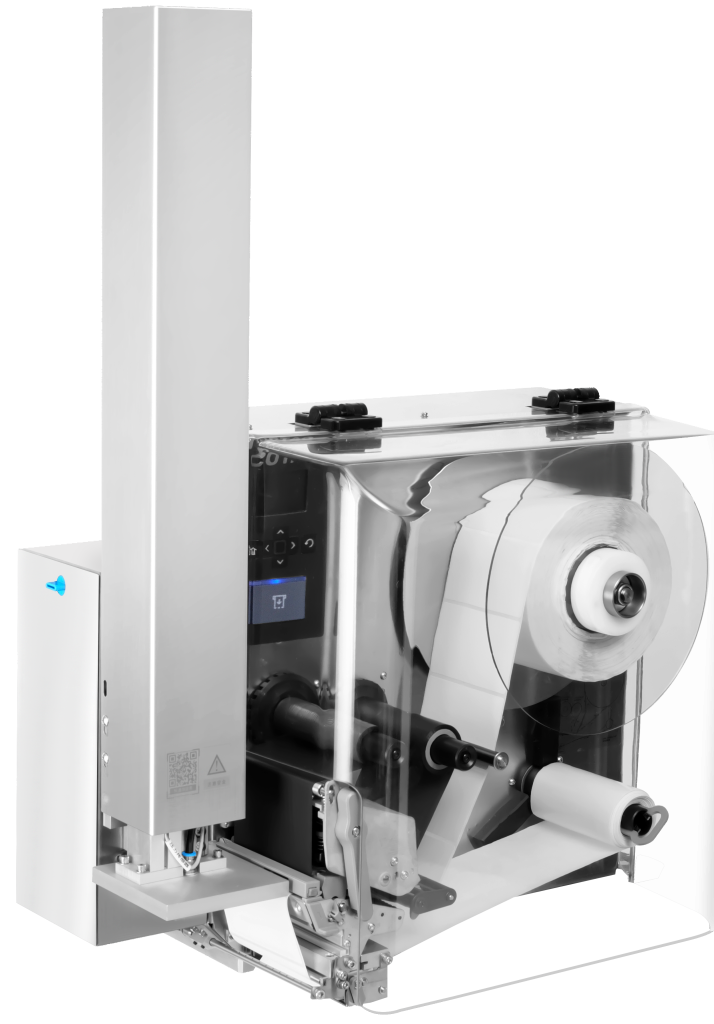
The printing section uses a print engine with 203 dpi thermal transfer printing, while the application section uses a pneumatic tamp labeling arm together with a tamp-blow labeling pad.
The system uses 45 × 25 mm labels, with a print-and-apply cycle of approximately 4 seconds per label and a repeat labeling accuracy of ±1.0 mm.
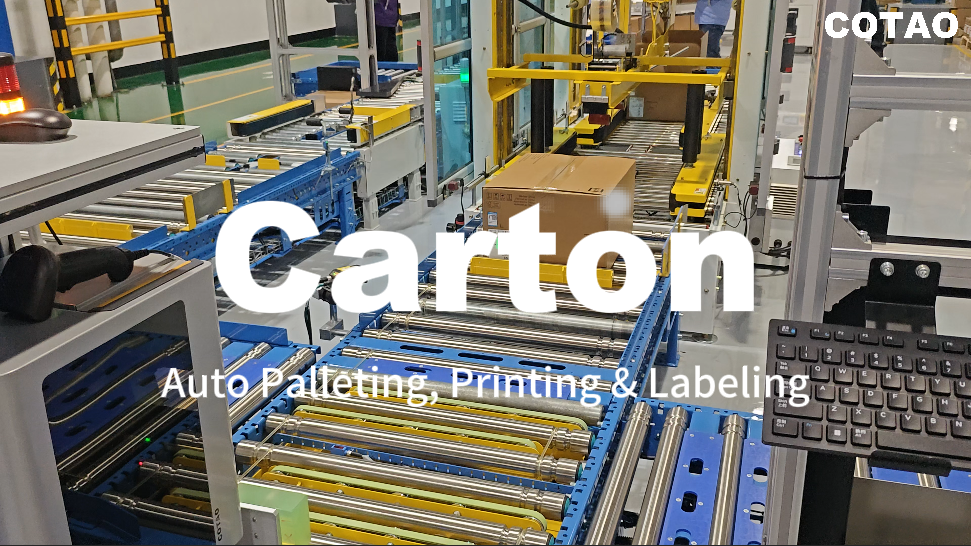
After cartons are sealed on the automated packaging line, they are transported to the labeling station by a roller conveyor.
According to the operating conditions defined for the project, labeling is performed while the carton is stationary. When a carton reaches the designated position, conveyor movement stops and the carton is aligned against the side guide to establish a stable reference position before the current print-and-apply cycle begins.
The print-and-apply system generates the corresponding label content in real time based on task data transmitted by the host system.
Label data can be transferred to the print-and-apply software via TCP/IP or other configured communication methods. The software then calls the predefined label template and controls the print engine, allowing barcodes, text, and other variable information to change dynamically according to the current packaging task.
Once the carton is confirmed to be in position and all print-and-apply conditions are satisfied, the PLC sends a start signal to the printer applicators.
After the label is printed, the pneumatic tamp arm extends and applies the label accurately to the specified side of the carton. When label application is complete, the equipment sends a completion signal back to the external PLC. The conveyor system then releases the carton from the labeling station and transfers it to the next process.
With this control method, the printer applicator is no longer an independently operating machine. Instead, it functions as an integrated execution node within the complete automated packaging line.
According to the technical requirements of the project, the print-and-apply system can exchange signals with the PLC for functions and statuses including labeling start, labeling complete, fault alarm, data ready, and equipment power/status information. This allows the production line to determine whether a carton should enter the labeling station according to the current operating condition of the equipment.
After print-and-apply labeling is completed, the carton continues along the conveyor system to the downstream automatic palletizing station.
The palletizing system then stacks the identified cartons onto the designated pallet according to the relevant production or logistics task, creating a continuous process that connects carton identification, automatic conveying, and palletizing.
The complete carton handling workflow can therefore be summarized as:
Automatic carton conveying → Positioning → Task data transmission → Real-time printing → Automatic label application → PLC completion confirmation → Automatic conveying → Downstream palletizing
This process is particularly suitable for manufacturers that already operate automated conveyor and palletizing systems.
Without changing the overall packaging and logistics workflow, the printer applicator can be integrated as the carton identification and data execution point, establishing a direct relationship between digital label data and the subsequent physical movement of each carton.
Results
Through the implementation of this project, the customer integrated carton label printing, manual label application, and downstream material handling into a more continuous automated packaging process.
The complete workflow now covers carton positioning, label generation, printing and application, downstream conveying, and palletizing.
Real-time print-and-apply labeling allows each carton to receive a label corresponding to the current production task. This reduces the need to print large quantities of labels in advance and manually match them to individual cartons, helping reduce the risk of incorrect or mixed label application at the data source.
The 203 dpi thermal transfer printing method provides clear printing of barcode and text information required for carton packaging labels. At the same time, the 45 × 25 mm label format, approximately 4-second print-and-apply cycle, and ±1.0 mm repeat labeling accuracy provide a stable basis for downstream automatic identification and continuous production.
Because each carton stops and is positioned at the designated labeling point before label application, variations caused by carton movement during conveying can be reduced, improving labeling consistency from carton to carton.
At the same time, PLC control coordinates carton arrival, print-and-apply start, labeling completion, and equipment status, allowing the conveyor system, printer applicator, and palletizing system to operate according to the same production sequence.
Once labeling is complete, the carton moves directly into the downstream palletizing process. This reduces additional manual handling and information transfer between labeling and palletizing, while allowing the product identity carried by the carton label to remain associated with the physical carton as it enters palletized logistics.
For manufacturers that already operate automated packaging lines, conveyor systems, and palletizing equipment, an automatic printer applicator effectively serves as an information execution terminal connecting production data with physical packaging.
Through real-time printing, automatic label application, and PLC integration, carton labels can remain associated with the current production task and continue supporting subsequent palletizing, warehousing, transportation, and product traceability.
As smart manufacturing and digital packaging continue to develop, the integration of automatic carton print-and-apply labeling + automated conveying + automatic palletizing brings carton identification directly into the complete packaging workflow.By reducing manual intervention, the system helps improve packaging information consistency, automation levels, and the efficiency of downstream logistics management.