
Keywords: automatic tire labeling, tire labeling, tire sidewall labeling, tire outbound shipping labels, tire sales labels, tire barcode traceability, anti-diversion labels, scan-to-print-and-apply, two-stage roll-down labeling, dynamic labeling, automated tire conveyor line, industrial printer applicator, tire logistics traceability
Demand
In tire manufacturing, warehousing, and sales outbound operations, labels are used not only to display product models, specifications, and sales-related information, but more importantly to establish a direct association between each physical tire and its inventory record, sales order, and outbound task. This provides the data foundation for sales traceability, outbound management, and anti-diversion control.
Unlike conventional cartons, tires are circular products with clearly curved surfaces. As tires move along the conveyor line, the labeling surface is not flat. If a conventional tamp applicator applies pressure only once to a limited area, the label may not adhere completely, resulting in lifted edges, trapped air bubbles, or unstable label positioning. Therefore, automated tire labeling must address not only the data question of “what information should be printed,” but also the mechanical challenge of “how to apply the label reliably to a curved surface.”
In addition, different tires may correspond to different product information, inventory records, and sales tasks during outbound operations. If labels are printed in batches in advance and operators must manually match them to the correct tires, the workload increases and the risk of mismatching labels and products also rises.
For this reason, the system needs to combine upstream automatic scanning, real-time data matching, and automatic labeling so that each tire is accurately associated with its corresponding label.
Solution
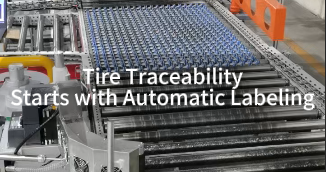
To meet the requirements of tire sales outbound operations and sales traceability, this project integrates upstream barcode scanning, automatic conveying, real-time label printing, and two-stage roll-down labeling into one coordinated workflow. Once a tire enters the conveyor line, the system automatically prints and applies the correct label according to the actual identity of that tire.
The tire first enters the operating area automatically via a roller conveyor. Before the print-and-apply process begins, an upstream scanner reads the tire’s existing product barcode or identification information and transmits the scanning result to the control system.
Based on the identified tire, the system matches the corresponding sales, inventory, or outbound label data and sends the required print content to the printer applicator.
This scan-to-print-and-apply process directly associates the label data with the tire currently on the line. Compared with pre-printing large batches of fixed labels, it reduces the need for operators to search for and manually match labels to products. It is also better suited to automated mixed-model production lines handling multiple tire specifications.
When the tire reaches the designated labeling position, the printer applicator prints the matched label in real time and automatically applies it to the tire sidewall.
Because tire sidewalls have significant curvature, this project uses a two-stage roll-down labeling mechanism specifically designed for tire surfaces. The label first makes initial contact and is positioned on the tire. The applicator then performs a second rolling action along the curved sidewall, gradually pressing the label from partial contact to full adhesion.
Compared with a simple single tamp application, two-stage roll-down labeling allows the label to conform more closely to the tire curvature, improving overall adhesion while reducing lifted edges, air bubbles, and partially unpressed areas.
The complete process is coordinated by the conveyor system, barcode scanner, printer applicator, and PLC control system:
Automatic tire conveying → Upstream barcode scanning → Product data matching → Label data transmission → Real-time printing → Two-stage roll-down labeling → Sales outbound shipping
The printed and applied label becomes an important identification carrier in tire sales and outbound operations, linking the physical tire with inventory records, sales tasks, and downstream logistics information.
Results
By implementing this automatic tire print-and-apply solution, the customer integrated previously separate scanning, label printing, and manual label application processes into one continuous automated workflow. The label is no longer simply an information carrier attached to the product surface; it becomes a data node connecting the physical tire, inventory system, sales task, and logistics process.
The solution delivers the following results:
- Automatic association between tire scans and label data.
After the upstream scanner identifies the current tire, the system generates the corresponding label based on the actual product identity, reducing the risk of mismatching tires and labels. - Automatic printing and application of outbound sales labels.
Labels are printed in real time according to the current outbound task, eliminating the need to pre-print and manually match large quantities of labels. - Improved label adhesion on curved tire surfaces.
The two-stage roll-down labeling mechanism conforms more effectively to the tire sidewall, providing smoother and more stable label adhesion. - A reliable foundation for tire sales traceability.
By associating barcode and label information, the system provides accurate data for inventory management, outbound identification, and downstream logistics tracking. - Support for anti-diversion management.
Tire identities, inventory tasks, and sales destinations can be associated through label codes, providing a data foundation for channel-flow tracking and anti-diversion control. - Reduced manual intervention and improved continuous throughput.
Scanning, data matching, printing, and labeling are automatically synchronized with the conveyor line, making the system suitable for high-volume continuous tire outbound operations.
In smart manufacturing and digital logistics environments, tire labeling is no longer simply about applying a label. It is an important part of product identity management and outbound sales traceability.By combining upstream barcode scanning with two-stage roll-down labeling, the COTAO automatic labeling system helps manufacturers establish a more reliable process for automatic tire identification, sales outbound traceability, and anti-diversion management, creating clearer and more accurate data links from production and warehousing through sales and distribution.