
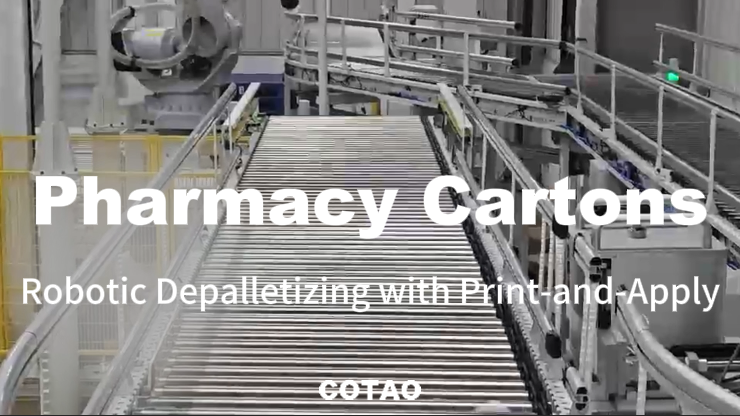
Keywords: print and apply, carton print and apply, automatic carton labeling, carton coding, automatic coding, robotic print and apply, robotic depalletizing, robotic depalletizing and labeling, print and apply automation, real-time print and apply labeling, industrial printer applicator
During pharmaceutical receiving, cartons serve not only as transport packaging but also as carriers of logistics information. Barcodes and variable data printed on labels need to be associated with internal logistics tasks so that cartons can be identified, put away, picked, sorted, conveyed, tracked and traced throughout subsequent warehouse operations.
When large volumes of pharmaceutical cartons need to be handled in coordination with robots, conveyor systems, WCS/WMS platforms and other automation systems, manual label printing and application can become labor-intensive. It also increases the risk of label data being incorrectly matched with the corresponding carton. Incorrect carton coding may lead to serious errors in pharmaceutical logistics and downstream handling.
To meet the customer’s automated inbound logistics requirements, COTAO integrated robotic depalletizing, automatic conveying, carton coding and print-and-apply into one coordinated workflow, enabling continuous operation from automatic depalletizing through label coding and application.
The project is mainly designed for automated receiving and internal carton handling at a pharmaceutical distribution facility.
Cartons are first picked and separated from pallets by a six-axis robot and then transferred onto a roller conveyor. Since different cartons correspond to different product sources and logistics data, fixed preprinted labels cannot meet the application requirements. Instead, the print-and-apply system must receive data from the host system and print and apply the corresponding label information in real time.
Several key challenges needed to be addressed.
First, the print-and-apply labeling system had to communicate with the six-axis robot, conveyor system and on-site control system so that printing and labeling would only begin after the carton reached the designated labeling position.
Second, a stable data communication mechanism was required. After the host system sends the label data associated with a specific carton, the print-and-apply software receives the information and transfers the required barcodes, text and other variable data to the labeling equipment.
Finally, the automated receiving process also needs to coordinate multiple system states, including equipment-ready signals, data-ready signals, alarms and carton-position signals, preventing cartons from continuing to the next workstation when an abnormal condition occurs.
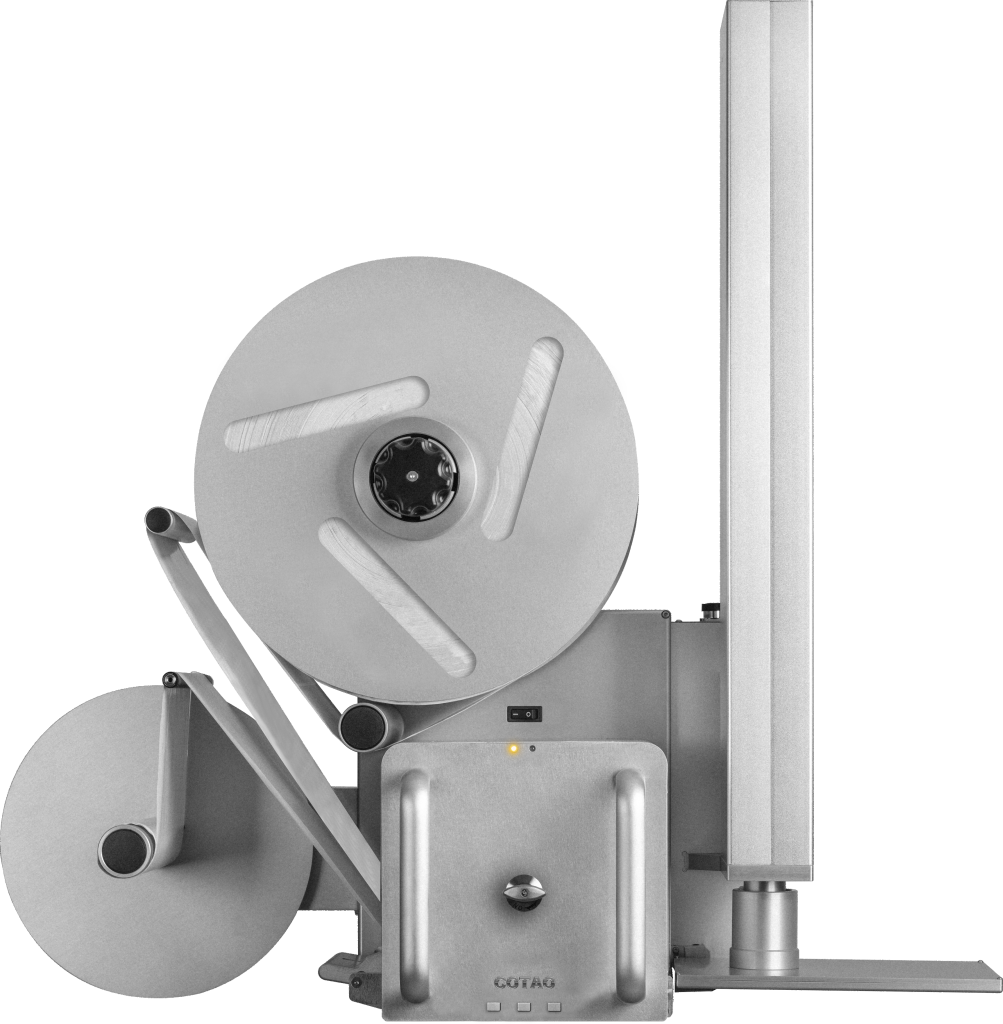
To meet these requirements, the project integrated a COTAO 70A a-Tamp DGM Printer Applicator into the carton conveyor and robotic handling system.
Robotic Depalletizing and Automatic Carton Conveying
After pharmaceutical products are unloaded, the depalletizing robot picks cartons from the pallet according to system tasks and places them onto the automated conveyor line one by one.
Once cartons enter the conveying system, they are transported and positioned at the designated print-and-apply labeling station according to the warehouse logistics process, preparing them for subsequent automatic coding and labeling.
The combination of robotic handling and automatic conveying reduces manual lifting and loading while enabling cartons to move continuously through downstream processes.
Host-System Data Transmission for Dynamic Carton Coding
The printer applicator exchanges data with the on-site host system.
When a logistics task is generated, systems such as the WCS or WMS can send data associated with the current carton to the print-and-apply software. Based on a predefined label template, the software generates the required print content and transfers the data to the printer applicator.
As a result, each carton can receive the appropriate barcode, logistics identification information and other variable data according to its actual task, rather than relying on batches of fixed labels printed in advance.
This approach links the logistics task, carton and label data, providing a reliable data foundation for subsequent carton identification, internal transfer and outbound shipment.
Real-Time Printing and Automatic Label Application
When a carton reaches the designated position, on-site sensors and the PLC confirm its status. The print-and-apply system then prints the corresponding label in real time based on the data already received.
After the label is printed and peeled from the liner, the applicator automatically applies it to the specified position on the carton.
To prevent positioning deviations and avoid lightweight cartons being pushed away during tamp application, a pneumatic clamping mechanism is installed opposite the applicator pad. It works together with the pneumatic applicator arm of the 70A to stabilize the carton before labeling, improving both labeling consistency and positional accuracy.
The entire process is completed without manual intervention.
Equipment Status and Exception-Handling Logic
In an automated logistics system, a print-and-apply labeler does not operate as an isolated machine. Instead, it acts as an execution node within the overall logistics automation system.
During on-site commissioning, COTAO therefore further optimized the signal-interaction logic between the print-and-apply equipment and the conveyor control system.
The system evaluates data status, equipment-ready status and alarm conditions to determine whether a carton is permitted to enter the labeling station.
If the labeling equipment enters an abnormal state, the conveyor control system can stop additional cartons from entering the station based on the exchanged signals. An alarm is also triggered automatically so that operators can respond promptly.
Depending on production requirements, the system can also work with automatic barcode scanning and manual label reprint functions to provide additional support for continuous operation and exception handling.
After on-site commissioning, production verification and continuous operational optimization, the print-and-apply system was successfully integrated with the robot, automatic conveyor line and host logistics system.
The complete carton-handling process can achieve:
Robotic Depalletizing → Automatic Conveying → Logistics Data Transmission → Carton Coding → Real-Time Printing → Real-Time Label Application → Barcode Scanning → Automatic Conveying
Compared with manual label printing and application, this solution combines label printing, carton identification and internal logistics tasks within one automated workflow.
It reduces manual involvement while avoiding the need to preprint large quantities of labels and manually match each label to the correct carton.
For pharmaceutical companies equipped with automated warehouses, robotic handling systems or WCS/WMS platforms, print-and-apply equipment can serve as an information execution terminal within the logistics automation system. It can dynamically code cartons according to the actual carton and logistics task, providing a basis for automated tracking and traceability during put-away, picking, sorting and outbound shipping.
The equipment is now in actual production use. Through continued production monitoring and optimization of system interaction logic and operating details, the print-and-apply system has been further adapted for stable operation within the automated logistics process.
Frequently Asked Questions
Why is carton coding required during inbound receiving?
Carton coding establishes an association between each carton and its corresponding product source or logistics information.
By printing barcodes, text and other variable information onto the label, downstream scanners and logistics systems can identify the carton and support automated tracking and traceability throughout put-away, picking, sorting and outbound shipping.
Can a print-and-apply labeler connect with WCS and WMS systems?
Yes.
Depending on the project requirements, the print-and-apply system can exchange data with host systems such as WCS and WMS through data interfaces, while communicating equipment status with the PLC through industrial control interfaces.
This enables coordinated operation involving data transmission, carton-position detection, printing, label application and equipment-status monitoring.
Why use real-time print-and-apply labeling instead of printing labels in advance?
In logistics applications requiring dynamic coding, different cartons may correspond to different product or logistics task information.
Real-time print-and-apply labeling generates the correct label based on the data associated with the current carton, reducing the need for operators to manually match preprinted labels with cartons.
This makes it particularly suitable for automated logistics systems.
Can robotic depalletizing be integrated directly with print-and-apply labeling equipment?
Yes.
The robot is mainly responsible for carton picking, depalletizing and separation. The cartons then enter the print-and-apply station through the conveyor system.
Through data and signal communication between the PLC, host system and print-and-apply software, robotic carton handling and automatic labeling can be integrated into one continuous workflow.
Why Was the COTAO 70A a-Tamp DGM Printer Applicator Selected for This Project?
1. High versatility for different carton and label sizes
The 70A supports label sizes ranging from 30 × 30 mm to 180 × 300 mm. Its 300 dpi print resolution provides clear printing of barcodes, text and other variable information.
The adaptive pneumatic tamp-blow application system supports both contact tamp application and non-contact blow application. In intermittent print-and-apply applications, the system can achieve speeds of up to 40 products per minute.
2. Robust construction for continuous operation
COTAO’s Servo-Print technology is designed for demanding industrial print-and-apply applications and supports continuous 24/7 production requirements.
The all-aluminum alloy machine body features a robust, precisely manufactured structure designed for stable and durable operation.
3. High-capacity consumables to reduce operator intervention
The system supports label rolls of up to 900 meters and ribbons of up to 1,200 meters, reducing the frequency of label and ribbon replacement and helping minimize production downtime.
In addition, the 70A is equipped with COTAO’s independently developed HOT 7 print-and-apply engine, and it is better suited to local operating and maintenance requirements. It also enables faster and more timely customer service support, helping ensure smooth and reliable operations at pharmaceutical distribution centers.
If you have similar requirements, please contact COTAO. We can design a suitable print-and-apply solution based on your carton dimensions, label size, labeling position, production throughput and existing automation system.